 The Daily Ubuntu
United States, 1963
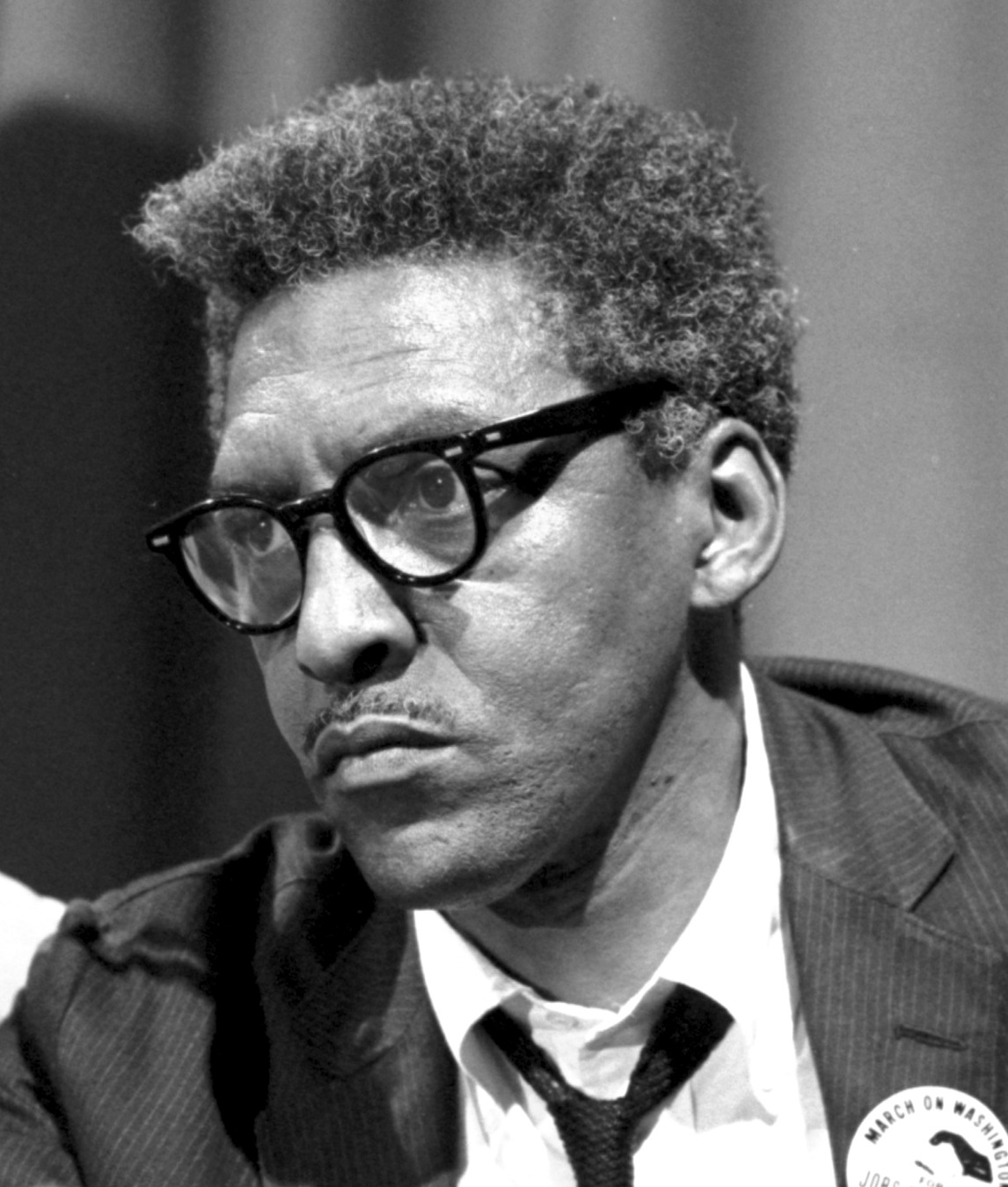
Bayard Rustin
A Quaker champion of non-violence, Bayard Rustin advised Martin Luther King Jr. and organized the 1963 March on Washington. Because he was gay, he was often kept in the shadow of the movement he served.
Inspiring Lives · Civil rights and diaspora
It was February 1956, in Montgomery, Alabama.
The city's Black residents were boycotting the buses. They went on foot.
A man watched them walk away. His name was Bayard Rustin. He wrote it down in his diary:
“I had a feeling that no force on earth can stop this movement.”
He had been born on March 17, 1912, in West Chester, Pennsylvania. He was one of twelve children. His grandparents, Janifer and Julia Rustin, raised him.
Julia was a Quaker and a member of the NAACP. His Quaker upbringing led him to non-violence.
In 1941, he joined a pacifist movement, the Fellowship of Reconciliation. He helped found the Congress of Racial Equality, CORE.
During the Second World War, he refused to take up arms. A conscientious objector, he spent more than two years in prison.
In 1947, with George Houser, he organized the Journey of Reconciliation. It was the first "Freedom Ride."
In North Carolina, he was sentenced to twenty-two days of hard labour, chained to other prisoners. He later told the story in the press. His report helped reform the practice.
In 1948, he spent seven weeks in India studying Gandhi's non-violence.
In 1953, in Pasadena, he was arrested and convicted for homosexual activity. He was asked to leave the Fellowship of Reconciliation.
He did not leave the struggle.
In 1956, he went to Montgomery. He advised the Reverend Martin Luther King Jr. on Gandhi's methods. In December, he proposed that they create an organization: it would become the Southern Christian Leadership Conference.
But because of what was said about him, Rustin mostly advised the leaders behind the scenes.
In 1963, a great project began: a March on Washington for Jobs and Freedom. A. Philip Randolph led it. Rustin became his deputy, and its chief organizer.
That year, a senator, Strom Thurmond, attacked him. He called him a Communist, a draft-dodger and a homosexual. He had the Pasadena record entered into the Congressional Record.
In August 1963, more than two hundred thousand people came to Washington.
Afterward, from 1965 to 1979, he led the A. Philip Randolph Institute.
From 1977 on, he shared his life with Walter Naegle. They stayed together until the end.
Bayard Rustin died on August 24, 1987, in New York.
On November 20, 2013, at the White House, the Presidential Medal of Freedom was awarded to him posthumously. Walter Naegle accepted it.
On February 5, 2020, California Governor Gavin Newsom pardoned him for his 1953 conviction.
Rustin came from the Quaker tradition. His way of fighting echoes Ubuntu, without being the same: he fought for an "us" that often did not include him.
In Montgomery, in 1956, people walked instead of taking the bus.
A man watched them, and already felt that nothing would stop them.
Sources
- Rustin, Bayard (Martin Luther King, Jr. Research and Education Institute, Stanford University) kinginstitute.stanford.edu
- Bayard Rustin (Wikipedia) en.wikipedia.org
Every figure on this page links to a verifiable public source.